

☕-Event Summary of Joint MfI Cafe with Mazda Motor Corporation-☕
| Date and Time | Thursday, March 19, 15:00 – 17:00 |
| Venue | W1-C-515 |
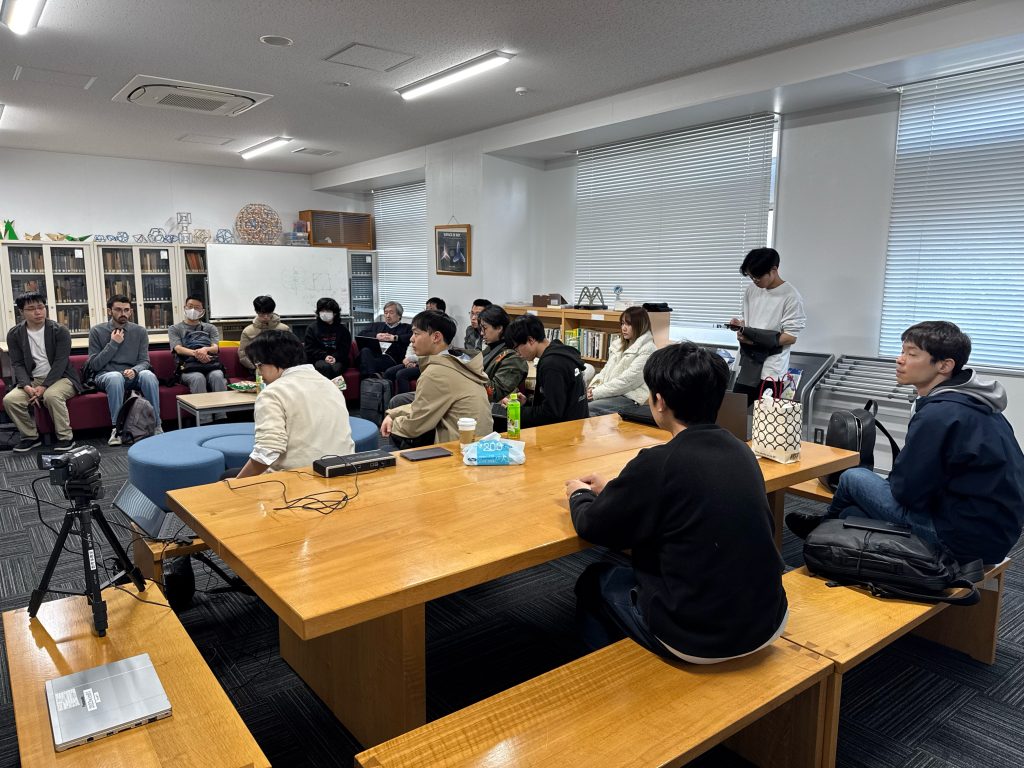
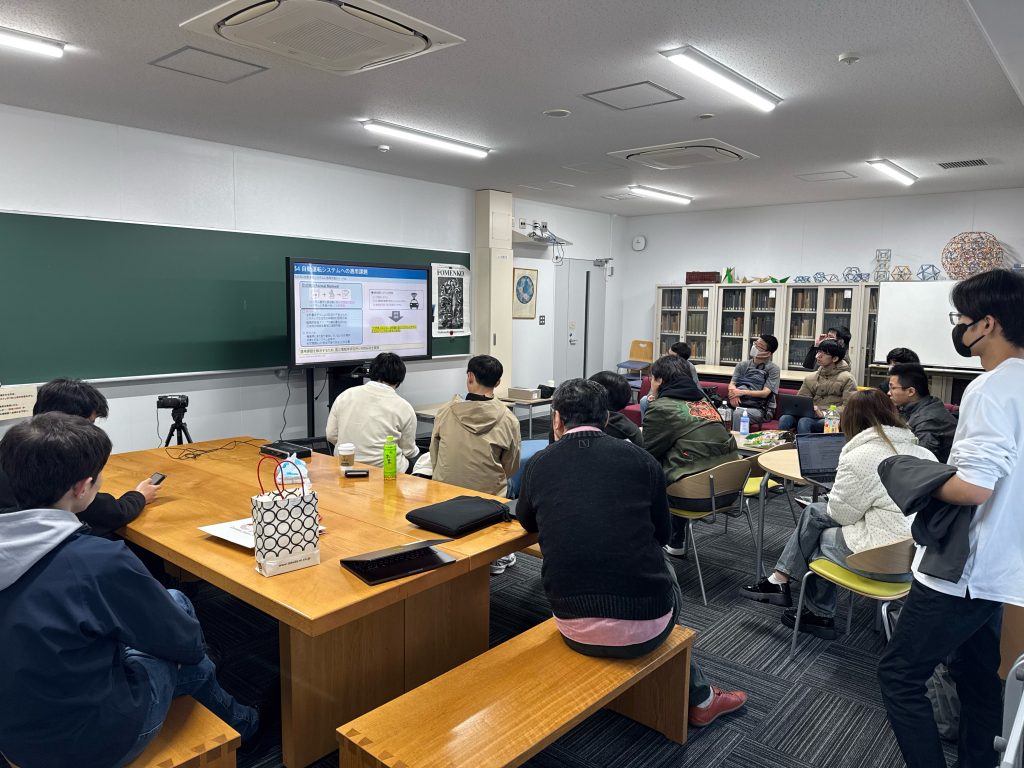
Event Summary
We hosted a Joint MfI Cafe with Mazda Corporation as our invited guests! Four employees with connections to Kyushu University gave presentations, sharing insights into their work at the company as well as their activities during their student days. The event was planned and carried out with the goal of helping students in JGMI envision their own futures.
Organizers:
Shota Shigetomi (Assistant Professor, Institute of Mathematics for Industry, Kyushu University)
Fumie Ogawa (Mazda Corporation)
<<Program Overview>> Speaker Introductions & Talk Summaries
- Takumi Ito (Online)
A presentation was given on case studies applying formal verification to safety assessment of autonomous driving systems, including collaborative research with the National Institute of Informatics (NII).
During his time in the department of mathematics at Kyushu University, he conducted research on elliptic curve theory under Professor Takeda.
<Presentation summary> Research and development related to formal verification was explained. As autonomous driving systems become more sophisticated, they are increasingly becoming “gray boxes.” Furthermore, the test-based verification that is mainstream in industry faces fundamental limitations in terms of coverage. While formal verification is an effective solution to this problem, challenges remain in applying it to black-box systems and to systems involving continuous values and derivatives. The presentation introduced ongoing efforts to address these challenges through joint research with NII. Students asked questions about specific examples of how mathematics is being applied to tackle critical issues in the automotive industry, giving the audience a clear picture of the connection to mathematical science. - Hirofumi Kunioka (Online)
A presentation was given on the optimization of materials and shapes in the early stages of vehicle model development, as well as on the correlation between measurements taken on actual vehicles and numerical values.
During his time in the department of mathematics at Kyushu University, he conducted research on discrete differential geometry under Professor Koiso.
<Presentation summary> The presentation explained how mathematics is utilized, using as examples the development of cross-sectional shape optimization technology and the development of vehicle body stiffness indicators for high-speed, high-G conditions — both pursued through CAE technology development. Questions were also raised about the challenges faced by someone with a mathematics background working in an environment close to mass-production development, and these were addressed as well. - Hiroshi Mizuno (Online)
He obtained an MBA from the Graduate School of Economics, Department of Business and Technology Management at Kyushu University, motivated by a desire to systematically study Management of Technology (MOT) and deepen his understanding of business management at a time when Chinese and Korean companies were rising to prominence in the electronics industry. He mentioned that his research focused on the management of firm boundaries, and that he had set a personal goal of launching his own business by the age of 45.
<Presentation summary> Students asked questions about the company overview, the scope and duties of each R&D division, and initiatives for developing Model-Based Development (MBD) human resources, and these topics formed the core of the explanation provided. - Fumie Ogawa
<Presentation summary> Questions were raised about the process of obtaining a doctorate while working in industry. The opportunity to earn a doctoral degree came in December 2019, guided by a division head at Mazda who was a Kyushu University graduate, on the topic of using statistical methods applied to internal combustion engine sensor data with the aim of achieving more efficient control. Completing a doctorate while continuing to work at a company was an extraordinarily difficult thing to see through to the end. Through obtaining the doctorate, work planning and the work itself became more stimulating, and it became possible to bring greater depth to technological development. Having loved mathematics since undergraduate days, I was a member of “Tosuu”
(都 数), a gathering of mathematics students from universities across Tokyo, where study sessions were held covering analysis, topology, algebra, vector calculus, and more. It was a relaxed and open-minded circle. https://tosuu.web.fc2.com
Refer to original page
